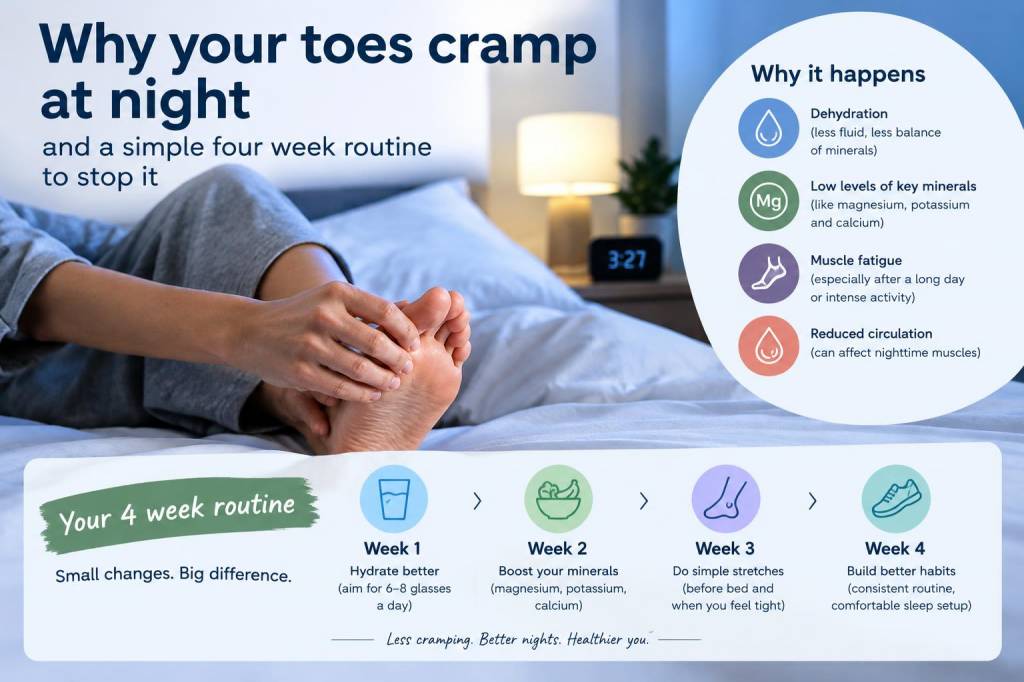
Nighttime toe cramps can feel sudden, sharp, and oddly personal, as if your feet have chosen the middle of sleep to make a complaint. I have seen this pattern again and again: a person goes to bed feeling fine, then wakes with a toe locked in a tight curl or a painful spasm that takes a few minutes to settle. It is frustrating, and it can make sleep feel less restful than it should be.
When I talk with people about this problem, I usually start by saying that toe cramps are often a signal, not a mystery. They can reflect muscle fatigue, hydration issues, footwear habits, nerve irritation, circulation changes, or a simple lack of mobility through the foot and ankle. In many cases, more than one factor is involved. That is why a small, steady routine often works better than a single dramatic fix.
Why toes cramp at night
Toes are small, but they do a lot of work. They stabilize each step, grip the ground, adapt to surfaces, and help absorb force. If I spend long hours in narrow shoes, stand for extended periods, or do a lot of walking without enough recovery, my feet may begin to feel tight by evening. At night, when I finally relax, those overworked muscles can spasm.
One common cause is simple muscle fatigue. If the muscles in the arch, calf, and front of the foot stay tense during the day, they may misfire at night. Dehydration can make that more likely, especially if I have been active, sweating more than usual, or drinking less water than usual. Low intake of electrolytes such as sodium, potassium, magnesium, and calcium may also play a role in some people, although I always stay careful about assuming that supplements are the answer without looking at the full picture.
Foot position matters too. Sleeping with the toes pointed downward can shorten the foot muscles for hours. For some people, that position is enough to trigger cramps. I also pay attention to tight calves, because limited calf flexibility can increase tension through the whole chain into the foot. If the ankle cannot move well, the toes often compensate.
Another factor is footwear. Shoes with a narrow toe box can keep the toes compressed all day, while unsupportive shoes can make the small muscles of the foot work harder than they should. I have also noticed that people who recently changed training volume, started a new sport, or increased hill walking may develop toe cramps because their feet are adapting to a different load.
Signs I watch for
Most nighttime toe cramps are harmless, but I pay attention to patterns. If cramps are rare and clearly linked to activity, footwear, or sleep position, I usually start with simple changes. If they happen often, feel severe, or come with numbness, swelling, weakness, color change, or burning pain, I think it is worth speaking with a clinician. Those features can suggest a problem that needs more than home care.
I also take cramps more seriously if they are accompanied by calf pain, if they start after a new medication, or if they are paired with symptoms such as unusual fatigue, thirst, or muscle weakness. Sometimes the feet are where a wider issue first shows up.
What I do before bed
My first goal is to make the feet less tense before sleep. I keep this simple and repeatable, because consistency matters more than intensity.
- I drink a glass of water in the evening if I have not had enough earlier in the day.
- I do a few minutes of calf stretching and foot movement.
- I avoid very tight socks or restrictive bedding that push the toes downward.
- I choose a relaxed sleeping position that lets my feet rest naturally.
- I massage the sole of the foot if it feels especially tight.
I do not try to force a deep stretch right before bed. If a stretch feels aggressive, it may irritate rather than help. I prefer gentle, controlled movement that signals safety to the nervous system.
A simple four-week routine I use with clients and for myself
This routine is designed to reduce cramping by improving mobility, circulation, and muscle endurance. It is short enough to fit into a normal evening, but structured enough to build change over time.
| Week | Focus | Daily routine |
|---|---|---|
| Week 1 | Release tension | Calf stretch, toe spread, light foot massage, hydration check |
| Week 2 | Improve mobility | Toe lifts, ankle circles, towel scrunches, gentle barefoot balance |
| Week 3 | Build endurance | Short foot exercises, single-leg balance, seated heel raises, nighttime stretch |
| Week 4 | Make it automatic | Repeat all movements, review footwear, refine sleep setup, continue hydration habits |
Week 1: calm tight muscles
During the first week, I focus on reducing baseline tension. Each evening, I spend two to three minutes on a wall calf stretch. I keep my heel grounded and lean forward until I feel a mild stretch along the back of the lower leg. I hold it for about 30 seconds, then switch sides.
After that, I sit and spread my toes as wide as I can without strain. I like this movement because it reminds the foot to lengthen after a long day of compression. I also rub the arch and the ball of the foot with my thumb or with a small ball, using light pressure. If I have a frozen water bottle, I sometimes roll it under the foot for one minute, especially after a busy day.
Week 2: restore motion
Once the feet are a little calmer, I add mobility work. I lift my toes while keeping the heel down, then press the toes down while lifting the forefoot slightly. This helps wake up the small muscles that support the toes and arch. I do slow ankle circles in both directions and stand on one foot for 20 to 30 seconds, holding a countertop if needed.
I also practice towel scrunches or marble pickups if my feet feel stiff. These are not flashy exercises, but they can make a real difference when done regularly. The goal is not to “burn out” the foot. The goal is to restore useful control.
Week 3: build endurance and support
By week three, I add a little more strength work. I do seated heel raises, then progress to standing heel raises if they feel comfortable. I also practice a simple “short foot” exercise: without curling the toes, I gently draw the ball of the foot toward the heel to activate the arch. This can improve foot stability and reduce overreliance on the toe flexors.
At this stage I pay close attention to recovery during the day. If I have walked a lot, worn unsupportive shoes, or stood for long stretches, I make sure I elevate my feet for a few minutes when possible. I also check whether my shoes are squeezing the front of my foot. A roomier toe box can be a surprisingly important part of the solution.
Week 4: turn it into a habit
In the final week, I keep the same movements but make them easier to sustain. I attach them to something I already do, such as brushing my teeth or changing into sleep clothes. That way, the routine does not rely on motivation alone.
I also review a few practical details:
- Are my daily shoes roomy enough in the toe area?
- Do my socks leave deep marks?
- Am I drinking enough water earlier in the day?
- Have I suddenly increased walking, running, or standing?
- Am I sleeping with my toes pointed downward for long periods?
If I answer yes to one or more of these, I adjust them one by one. I do not try to change everything at once, because that usually leads to frustration rather than progress.
What I do during a cramp
If a cramp hits anyway, I stay calm and move the foot in the opposite direction of the spasm. If the toes are curling downward, I gently pull them upward toward the shin. I stand or sit and slowly put weight through the foot if that feels safe. A brief massage or a warm compress can help afterward. I do not yank hard on the toes, because that can make the area more irritated.
After the cramp eases, I usually walk for a minute or two and drink some water. If the foot remains sensitive, I treat it kindly for the rest of the night instead of pushing through more stretching.
When I look beyond the foot itself
Sometimes toe cramps are only part of the story. I think about overall movement, stress, sleep quality, and nutrition. A body that is run down, under-recovered, or under-fueled may show it first in the feet, because feet are asked to do so much with so little attention. I also consider whether I have been more tense than usual. When stress is high, many people unconsciously clench through the feet and toes just as they do through the jaw or shoulders.
If cramps keep returning despite a solid routine, I would rather investigate than guess. A health professional can review medications, circulation, nerve function, and possible nutrient issues, and can help rule out other causes. For me, that step is part of good care, not a sign of failure.