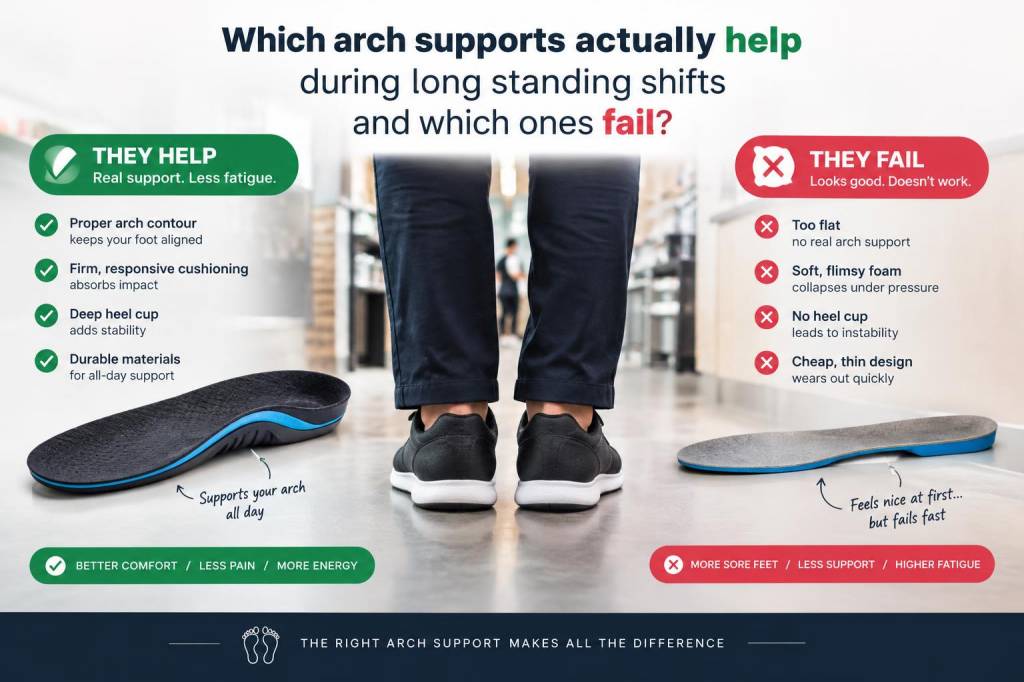
When I talk about long standing shifts, I am not talking about a vague ache that shows up once in a while. I mean those hours when your feet feel like they are slowly flattening into the floor, your calves tighten, your lower back starts sending little warnings, and every break feels too short. In that setting, arch supports can be genuinely helpful, but not all of them do the same job. Some absorb load and improve alignment in a way that makes standing feel more manageable. Others merely feel cushy for a short time and then collapse, slide, pinch, or create new pressure points.
I have spent enough time looking at foot mechanics, shoe construction, and real-world wear patterns to know that people often buy arch supports for the wrong reason. They may be chasing softness when what they actually need is structure. Or they may need a small change in pressure distribution, yet they end up with a rigid insert that feels like a brick. The difference matters, especially during long shifts where your body repeats the same posture for hours.
What an arch support can truly do during long standing work
A useful arch support is not magic. It does not remove the demands of standing, and it will not erase fatigue if your shoes are poor, your work surface is unforgiving, or your calf strength is limited. What it can do is redistribute stress. A good support can reduce strain under the heel and forefoot, decrease excessive collapse through the midfoot, and help the shoe work with your foot rather than against it.
For me, the most helpful supports usually do three things at once:
- They fill the gap under a lower or moderate arch without forcing the foot into an unnatural position.
- They stay stable inside the shoe so the foot does not work harder to find balance.
- They keep pressure from concentrating under one sore spot for too long.
That last point is important. Many people think arch support is mainly about the arch itself, but the real benefit often comes from load sharing. If the insert helps spread force across the whole plantar surface, the shift can feel less punishing after several hours.
Supports that usually help most
In my experience, the most reliable options for long standing shifts tend to be semirigid orthotic inserts or well-designed over-the-counter supports with a shaped heel cup and moderate arch contour. These are often more effective than ultra-soft foam pads because they hold their shape under repeated compression.
Semirigid devices work well because they balance cushioning and control. They are firm enough to support the midfoot, yet they still allow some natural movement. That matters during long standing work, since a completely rigid insert can feel aggressive and a completely soft one can bottom out too quickly.
I also find that inserts with a deep heel cup often perform better than flat arch pads. A heel cup can improve rearfoot stability, and that stability can make the arch feel less overloaded. When the heel is secure, the rest of the foot often does less compensating.
Another category that can help is full-length insoles made from layered materials. A top layer may provide immediate comfort, while a denser base layer limits collapse over time. This kind of construction tends to suit people who stand on hard floors and need support that lasts through an entire shift rather than only during the first hour.
Supports that often fail in real life
Some products look promising in a box and disappoint badly after a few hours on the job. The most common failure I see is the soft foam arch pad. It may feel pleasant when you first slip it in, but under prolonged load it often compresses too much. Once that happens, the foot sinks, the arch loses support, and the device becomes little more than a thin cushion.
Very aggressive arch supports can also fail, even if they are high quality. If the arch contour is too high for your foot, you may feel pressure in the middle of the foot, rubbing along the inner edge, or a strange sense that you are standing on a ridge rather than being supported. A support that is too forceful can make you shift your weight in awkward ways, which may worsen fatigue in the calves, knees, or hips.
I am also cautious about sticky gel pads marketed as universal solutions. Some of them slide around, trap heat, or create a squishy unstable feeling that the foot has to fight against. Stability matters more than novelty. If your foot is constantly adjusting to an insert, the insert is not doing useful work.
Cheap half-length inserts can fail too, especially when they leave the forefoot unsupported. During long standing shifts, the front of the foot often carries substantial load. If the insert stops too early, pressure can build exactly where you are already vulnerable.
What makes one arch support work while another fails
The answer is rarely branding alone. It usually comes down to fit, stiffness, shape, and shoe compatibility. A support that works beautifully in one shoe may feel terrible in another because the foot sits higher, the heel slips, or the toe box becomes cramped.
Here are the main factors I pay attention to:
- Arch height match: The shape must suit your foot, not an idealized version of it.
- Material density: Softer is not always better if you stand for many hours.
- Heel stability: A secure heel cup can reduce excessive motion.
- Full contact: The insert should support the foot without leaving awkward gaps or pressure ridges.
- Room in the shoe: A support that crowds the shoe will often cause new problems.
I also think people underestimate adaptation. A support can be technically good yet still feel unfamiliar at first. Mild adjustment is normal. Sharp pain, numbness, pinching, or worsening discomfort is not. If a product creates symptoms that were not there before, I treat that as a sign to reassess rather than push through.
What I look for when choosing support for a long shift
If I were helping someone choose a support for standing work, I would ask about three things first: where the pain shows up, what kind of shoes they wear, and how hard the floor is. A person who stands on concrete in unsupportive shoes has a very different need from someone in cushioned sneakers on a softer surface.
For many people, I prefer a moderate arch profile over an extreme one. Moderate support is more adaptable and less likely to cause irritation during long wear. I also like materials that rebound consistently after compression. If the support sinks and stays sunk, it is not ready for a workday.
Brand can matter, but not as much as many people think. Some well-known orthotic brands offer structured inserts with good durability, including Superfeet, Powerstep, Currex, and Tread Labs. I do not assume any brand will suit every foot, though. I care more about the actual shape and how it behaves in the shoe than the label on the package.
If someone has very specific foot pain, especially persistent arch pain, heel pain, or symptoms that travel upward into the ankle or knee, I would rather see a more individualized approach. Off-the-shelf supports can be excellent, but they are not always enough for every foot type or injury history.
Common signs that a support is not right for you
I often tell people to notice how their body responds after the first few shifts, not just during the first ten minutes. A bad support can feel acceptable at first and still be wrong overall.
| What you notice | What it may mean | What I would consider |
|---|---|---|
| New pressure in the arch | Contour may be too high or too firm | Try a lower profile or more gradual shape |
| Heel slipping | Insert may be too thick or shoe may be too shallow | Check shoe volume and heel fit |
| Forefoot burning | Load may be shifting forward | Look for full-length support and better cushioning |
| Arch feels good early, then collapses | Foam may be too soft for the shift length | Move to a denser, more structured insert |
| Knee or hip discomfort increases | Alignment may have changed in a way your body dislikes | Reassess fit and stop if symptoms persist |
Why shoes matter as much as supports
I do not separate arch supports from shoes, because they work as a pair. A support in a poor shoe often fails. A stable insert inside a shoe with enough depth, a secure heel, and a reasonably roomy toe box tends to work far better than the same insert squeezed into a narrow, worn-out shoe.
If the shoe is already collapsing at the midsole, an insert cannot fully rescue it. If the outsole is uneven, the foot will still compensate. If the toe box is tight, adding support may simply create more crowding. That is why some people blame the arch support when the real problem is the shoe environment around it.
For long standing shifts, I usually value a shoe that is stable, not overly flexible, and not excessively soft. The goal is to reduce unnecessary effort while keeping enough comfort to tolerate hours on your feet. The right arch support should enhance that balance, not fight against it.
Small adjustments that make support work better
Even a good arch support can underperform if your whole setup is off. I pay attention to socks, fit, and wear habits because they influence comfort more than people expect.
- Use socks that reduce friction and do not bunch under the arch.
- Replace worn shoes before the midsole becomes unstable.
- Try both feet separately, since many people have slight asymmetry.
- Break in a new insert gradually over several shifts.
- Pay attention to standing posture and shift weight periodically rather than locking into one position.
I also like to remind people that supports are only one part of the picture. Calf flexibility, foot strength, and brief movement breaks can change how an insert feels over time. A support may seem mediocre in isolation, but become far more effective when the rest of the system is cared for.
When I would skip arch supports altogether
There are moments when I would not reach for an arch support first. If someone has acute pain, swelling, numbness, nerve-like symptoms, or pain after an injury, I want the cause assessed rather than masked. If a support makes symptoms worse after a sensible trial, I do not keep forcing it.
I also hesitate when a person has already tried several inserts and every single one has caused discomfort. That pattern can signal that the problem is not simply support height. It may relate to shoe size, foot structure, workload, or a separate issue that needs more focused care.
What I want for long standing shifts is not just an insert that sounds impressive. I want something that keeps working after hours of compression, stays comfortable when fatigue sets in, and lets the rest of the body move with less strain. When arch supports do that, they can make a very real difference. When they fail, they usually fail for predictable reasons: too soft, too high, too narrow, too unstable, or paired with the wrong shoe.